
This is an old revision of the document!
Highly interactive
Video Games

Entertainment medium of the future
Extraction
Helldivers 2
DEFCON (Game)
The Crew
Rebel Inc.
F1 Manager 2023
Stop Killing Games
Video Games/Assets/Extraction
Unreal Engine Extraction
What You Need
You are lucky! For the longest time, extracting assets from Unreal games was the biggest pain in the ass you could imagine. In fact, I collected an ungodly list of tools for entering Unreal games, but you will only need one: FModel. I created an entry in my list of tools, but you can just google for it or take this direct link to their Github page.
Fmodel is quite amazing - for beginners, It does the job of dealing with .pak and .utoc archives. Back in the days, you had to do this with a funny script that you downloaded from a funny website, which then revealed .uasset files which you had to load into a different program that then let you extract files from there. Back then you needed QuickBMS, and then you needed UModel, and then you needed a way to figure out WWise. Fmodel does all of this for you!
Additionally, there are some good odds that you will need jmap. See their Github page. You will probably be interested in the jmap_dumper-x86_64-pc-windows-msvc.zip file.
Step 0
In many cases, it can be useful to make a copy of the game folders. This way you can work on the game files without touching the actual installation of the game, ie. you don't break anything. This is not strictly necessary but I like to do it to have a distinct “working directory” instead of working with the live game files.
Step 1
Your main weapon of choice will be FModel. The important step to working with Fmodel is configuring it correctly. On the top menu, open Settings.
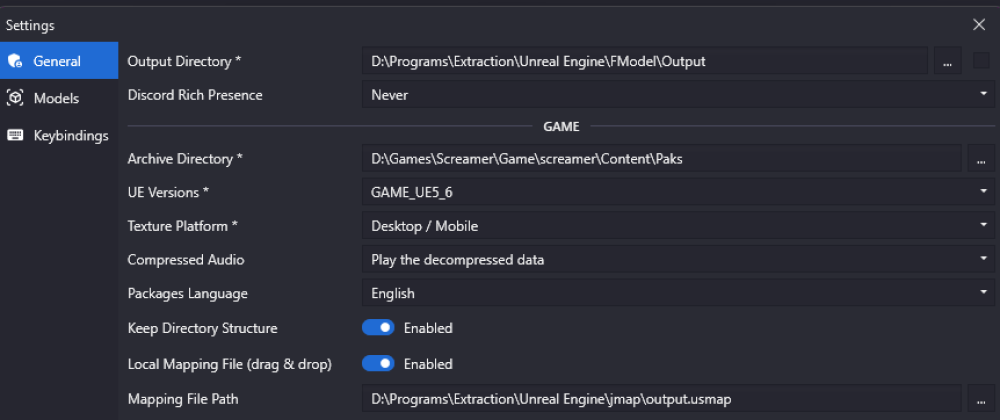
Ignore the exact settings shown in the screenshot. This is to be used for orientation so that you know where to look at. For now, you should focus only on the strictly necessary settings. The strictly necessary settings here are marked with a star:
- Output Directory is the folder to which Fmodel will extract when you extract files. This can be anything, select something convenient.
- Archive Directory is the folder containing the game files. This can be the files from the actual game folder, or it can be a copy of the game folder you placed elsewhere. Importantly, the selected folder must contain the
.pakand.utocfiles. - UE Version is the version of Unreal Engine that was used during development of the game. See below for help on determining this.
- Texture Platform is a setting that determines how the game's textures will be read. Unreal Engine saves them differently based on platform, if you are extracting from the files of a Desktop game then you will want to select
Desktop/Mobile.
Step 2
During settings or after, FModel will potentially ask you to restart. Let it do that and you should now be looking at something like this:
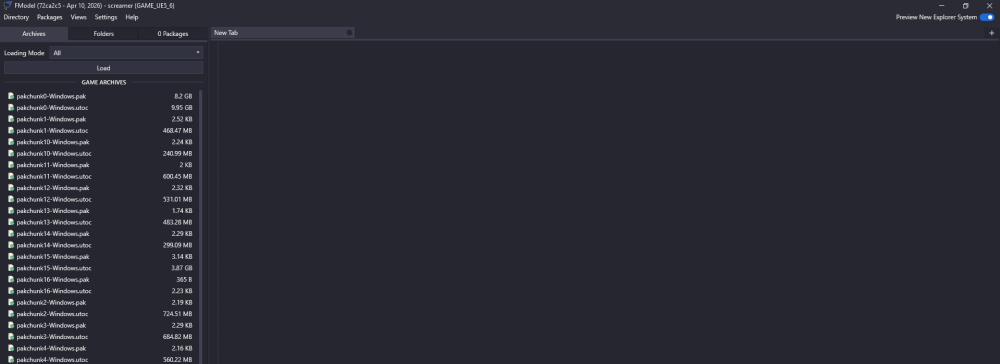 Again, the exact details here don't matter. What matters is that you see a list of files on the left and a blank screen on the right.
On the top left you will see an option called Loading Mode with a dropdown menu. Open the dropdown and select All. Then hit the Load button underneath.
You should now be looking at something like this:
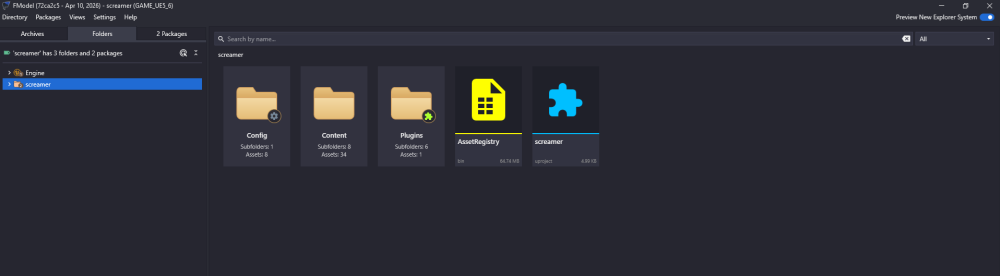
Congratulations, you are in!
Step 3
This is a good start and will often already get you pretty far into the game's assets. Thanks to FModel, you don't even have to worry about WWise or other audio handlers, as FModel lets you play .wem and .bank files right inside the application and allows you to export them to .wav so that you don't even have to ever touch any WWise related stuff.
However, in many cases you will be wanting to look into .uasset files, in which case the program will throw an error in the console below. It will mention “Unversioned Properties” or “Missing Mappings”. These errors are related to how Unreal Indexes its files and is a bit involved to explain. In short, FModel needs a file that maps assets stored in files to.. something? I'm not 100% sure myself, but the importantly what you need now is a .usmap file. To do that you will need to use jmap.
After downloading jmap you should have a file called jmap_dumper.exe. This is a command line program that lets you generate a .usmap file for your game. To do that, you will need to open command prompt and navigate to the folder that jmap_dumper.exe is in.
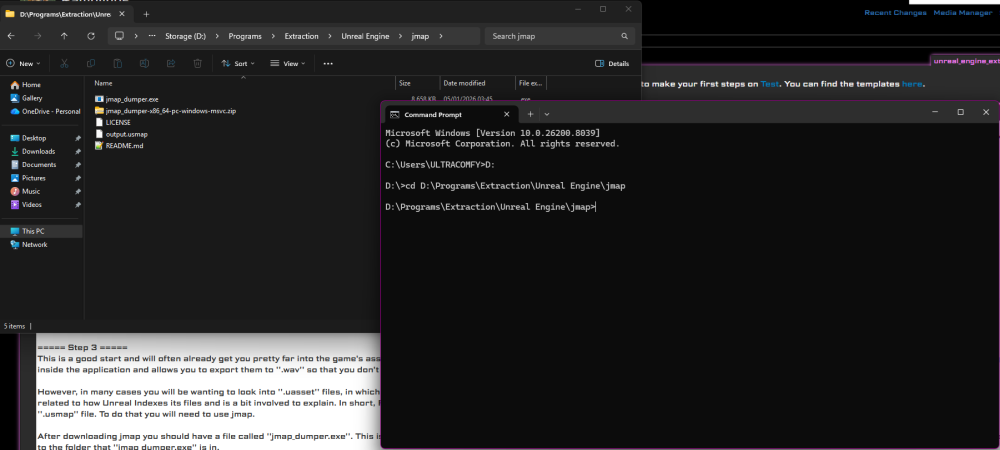 Note that the folder is probably different for you. My jmap dumper is in
 D:\Programs\Extraction\Unreal Engine\jmap but it can be anywhere for you.
jmap only works when the game is running, as it pulls its data from the active game process.