
This is an old revision of the document!

Screamer
“High-octane action and anime aesthetics collide in this arcade racing game, featuring fighting mechanics and a storyline that hits hard. In this world, some race for glory while others seek power or revenge. Every race is a fight and every battle is personal.”
Highly interactive
Video Games

Entertainment medium of the future
Extraction
Helldivers 2
DEFCON (Game)
The Crew
Rebel Inc.
F1 Manager 2023
Stop Killing Games
Video Games/Racing/
Screamer
Screamer is a 2026 arcade racing video game developed by Milestone S.r.l., an Italian subsidy of Plaion (formerly Koch Media), which itself is a subsidy of Embracer, although you might know them better under their former name THQ Nordic AB. Screamer is a twin stick powered up arcade car racing game that caught my attention during the 2024 Game Awards. They showed this trailer in which a car appeared that had glowing neon text on it in a Neo/Neon-Noir world setting. That car, with the neon sign on it? Yes, I love flashy lights and stylistic signs like these, so I put it on my wishlist and kinda didn't think much longer about it.
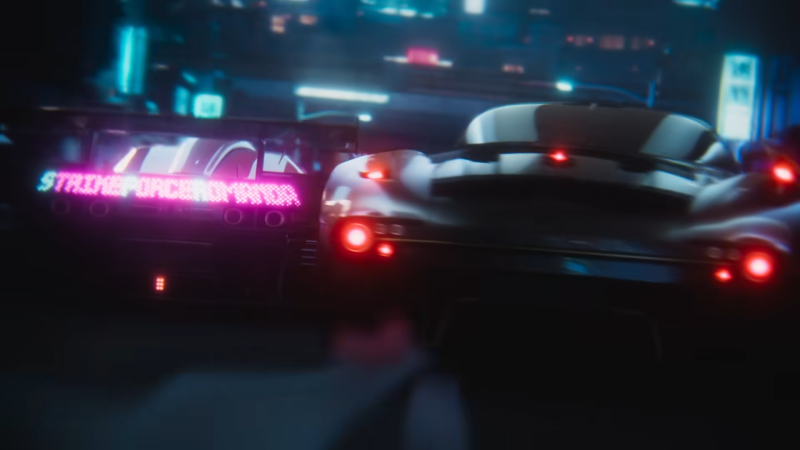
Yes. YES! Give me that car.
Now at the time I didn't know what “Strike Force Romanda” was, but it sounded pretty cool so I didn't mind. Sometime through 2025 I saw that the developers made a series of videos about Screamer and what the game was about. Since it's a racing game I was primarily interested in the game's mechanics, hoping that there was going to be something that would make Screamer stand out in the racing genre, which had become rather stagnant during the last decade or so. Don't get me wrong, racing games are still played plentifully - between iRacing, Automobilista 2, Assetto Corsa, BeamNG Drive, F1, Mario Kart or even the occasional Need For Speed, there is no shortage of players playing racers (90% of which are probably frothing out of their mouth right now because I didn't mention their particular racing game). Despite the persistent enthusiasm for racing games, however, there hasn't been a lot of innovation in trying to create new, different ways to race, especially in the arcade racing field of video games.
So I watched the developer's video on the game's mechanics and, admittedly, it didn't make me a lot more knowledgeable of the game. The things they said were interesting, but I didn't really… understand? them from the video. But either way, what I saw in the video still gave me the impression that I was looking at a game that was at least decent and had the potential to be great. The visuals are on point, the cars are still what I remembered from the Game Awards trailer, the racing looked exciting; I didn't understand the mechanics but really that meant that this was potentially going to be more than “just another arcade racer”. What I saw was intriguing - put it that way.
The following sections contain moderate to severe gameplay and story spoilers.
Gameplay
Since I didn't learn too much from the gameplay breakdown video, I went into the game without really knowing what to expect. Really, primarily I just wanted to play that cool car with the neon sign design.
The start of the game is interesting in that it starts rather slowly but also very fast at the same time. The story happens very quickly as it introduces a lot of characters, over 15, very quickly, each with their own conflicts and motivations. In fact, there are so many conflicts and rivalries and motivations and names that it got really hard for me to keep track of. I'm already really bad with names and anything not introduced to me in gameplay terms will always take a bit longer until I actually “get it”. The driving happens comparatively slowly. The game introduces its mechanics very incrementally and starts you out very “pure”, ie. no abilities, not even drifting, just throttle and steer. I appreciate that a lot as I like to get very familiar with a game's mechanics before putting them into action. Still, even with these “simple” mechanics there is a lot to learn, and the game kind of allows you to just do whatever. Many driving styles work, especially during the beginning, so it gets kind of difficult to unlearn if halfway through the main story you realize that, maybe, refusing to hit the brakes before every turn is actually not the fastest way to get around the track. This is made more difficult because the game keeps introducing more and more characters to the plot and makes you drive the cars of every character. Every character brings their own car to the tournament, and these cars differ very strongly from each other. A driving strategy, even if it is “wrong”, may work for one car but will not work for another, which makes it easier to “learn the wrong thing”, harder to dislodge wrong things and harder to identify problems in the first place, especially given the lenient systems that kinda just let you roll with wrong cornering strategies. More on that in a second.
Cornering
I come from a racing rich gaming background. I've played Moorhuhn Kart 2, Mario Kart Wii, Wreckfest, Grid 2, Assetto Corsa, F1, Blur, Redout, Combat Racing and many, many more. Particularly my experience from Redout and Blur were useful in understanding this game, but they partly also led me to misinterpreting the game. Early on, after playing with the “pure” car, the game introduces drifting. Drifting in this game is done by two more keys that can instantly commence a drift in the direction of the drift key. There is one for left and one for right. This is different from most drifting systems, especially the Mario Kart style drifting most players will be used to, in which you “lock in” the direction of the drift with the drift key and then modulate normally using the steering of the car. Thanks to Redout I am used to a kind of drifting style where the car kind of breaks out behind you and is pulled away from the corner. That's what this game does and why the “twin-stick drifting”, as the reviews call it, needs the twin stick. I am perfectly used to this and love how this game has a drifting system that is… comparable to Redout, but still entirely different and serves an entirely different purpose too. The purpose, that is, in Screamer is to change the direction of the car. The car is attached to the ground and drifting is strictly faster in getting the car to change its direction than traditional steering. In Redout, this is called strafing and isn't primarily used to change the racecraft's direction of momentum. Redout raceships are not attached to the ground, so turning them around has no effect on their momentum at all. Instead, in Redout the strafing is useful primarily to get the ship to point in a different direction. However, pointing the car in a direction and actually going where you're looking are two very different things in that game, and making the ship change course still needs to be done seperately. Screamer is different of course, since with its tires on the floor it always generates traction in the direction of where the car is looking. Still, these two cornering systems, genetically, share a common ancestor, which made racing in Screamer feel comfortable and intuitive, even though it is different and I have a lot to learn to get really good at it. Reviews really don't like it and, knowing how difficult it was for me to get into Redout, I can understand where they are coming from. They're still wrong, though.
This brings us to the thing where I said “more on that in a second”. In Redout, the correct way of taking a turn often involves tapping the barrier on the exit of the turn. That just is the fastest way to drive in many corners. That is intentional and the game is designed around making taps with the barrier not a punishment, but a proper, non-punished way of taking turns. Getting into the Redout mindset, I started playing Screamer the way I play Redout, putting myself into the barrier on the outside of a turn because I took in too much speed and didn't realize that eating the barrier is actually slower. This… worked. For a long, long time the game just let me do that as the tracks were mostly straight and didn't communicate that braking is necessary. Of course I'd lose speed in those corners, but if I brake I'd lose speed as well. At the time I didn't even know how much braking force these cars had because I was thinking in Redout and Mario Kart terms, and in those games you just do not release the throttle. I saw the problem in that turn but thought that it was maybe just a particularly difficult turn that I have to drive into at a better angle. In video game design terms, the game's feedback clarity (ie. walling it into turns is wrong) is low, which makes it difficult to move on from. More on that, again, later.
Collisions
In terms of feel, interacting with other cars reminded me mostly of Blur, something it will get compared to a lot. If it's any kind of collision, be it with other cars or track limits of any kind, the ways these collisions eat into your momentum and feed into your weight transfer, induce spins, etc., is mostly similar to what I've learned to expect in Blur. Collisions in Screamer, however, felt more fleshed out, more “significant” but also at the same time “smoother” and - in a good way - gamier. My personal favorite are the collisions from Mario Kart Wii, a very “clashy” physics engine where two cars collide and bounce away from each other like marbles, accompanied by a satisfying “CLASH” sound. Most games are really boring with their collisions, like the later Mario Kart games where cars mostly just squish or crease into each other without much happening unless there are serious weight differences between the cars. Blur back then had a very “rubbin is racing” kind of feel to collisions where cars often sustained their contact through into, through and out of corners, rubbing along each other often even on the straights. Screamer is different. Cars don't hook into each other and refuse to let go. Its collisions are more discrete and, while rubbing exists, it's not anywhere as prevalent as in Blur. Now, it is possible to get stuck in the rear of a car ahead, but the physics (and systems) don't act to maintain that lock. It is very easy to unlock yourself out of that situation.
Also, unlike the cars in Blur, Screamer cars can be “bounced”. If you wanna boost into a corner and use the car ahead as a guardrail, that is entirely possible. Slower collisions don't really do very much, but boosting into other cars with high speed can really take them across the track, even if it takes some effort to pull off. Obviously this isn't “impossible” in Blur, but Blur's cars resist that outward motion that you impart on them a great deal more than cars in Screamer do.
The other part, track limits, is another reason to like Screamer. Going into a wall in Screamer feels hefty and discrete. Screamer has found the middle ground between bouncy wall collisions like Mario Kart, and grindy wall collisions like most racing simulators will have them. Screamer leans towards the grindy collisions, wherein the car is redirected into the direction of the wall, slowed down and receives friction from the wall, minus the part where cars tend to hook into the wall and refuse to let go. Screamer likes to just let you go mostly unscathed. Taps on the guardrail don't upset the balance or kick you out of your drift, and you don't get eaten up into the guardrail. Sure, it will cost you some speed, but overall this system is very forgiving and wants to see you continue where reasonable. Now, for harder hits, it will slam your side square into the wall and it will deduct from your speed, but the walls are made so that you can get back out of them near-instantly and get back up to speed. There is no additional friction, unless you keep grinding into the wall. The goal here seemed to have been to accept that the track has to have limits somewhere, but to let you continue to engage with the game's systems as much as possible or - in case you hit it harder - to act as a redirection tool that can be used to take turns really fast if combined with a boost or dash.
Many games have no real collisions anymore at all and won't ever let you properly spin yourself out. Their tracks are mostly just tunnels with no sharp edges, and you'd have to work really hard to crash your car square-on into a wall, as these tunnels kinda just always redirect you back into the direction of the corner. This game is different. It will seem rather tunnelly at first, but you will quickly find out that, no, sharp edges exist in this game, and they can hurt you. In fact, they will properly crash and spin you around if you don't watch out, even with the game's lenient collisions. There is also no crash cam or anything that would prevent you from ever having to deal with the consequences of such an event. High speed collisions don't crash you out, show you a quick animation and then reset you to track - no, you have to reverse out of that hole, turn the car around and accept your fate.
Driving
Important detail: Cars and drivers belong together! You cannot select a driver and a car pairing independently. When I say that different drivers have different abilities, and that the cars have different personalities, I really am mostly talking about the same thing.
The cars are responsive and predictable. One thing I like about the game in particular is the active upshift. As someone who came to racing from Mario Kart and Need for Speed, and who only just recently started playing without assists in games like F1 or Assetto Corsa, manual gearboxes are very scary to me. But I understand why you want gear shifting in your game, as it gives you something to do and makes you more intimately connected with the car you're driving. Screamer did it perfectly, because it rewards you for doing it. In most games shifting is something you just do, and the only thing that happens is that you get punished for doing it at the wrong time. There is no real incentive and it still feels nice, but it's not quite there. Screamer actively rewards you for shifting - it gives you a speed boost and grants you “Sync”, a resource you can use later to get a speed boost or a shield. The speed boost is very powerful and often the fastest way to get out of some of the tightest corners on the tracks, so you really want that Sync resource. And that brings us back to Active Shift, the shifting mechanic in Screamer that gives you a small speed boost and Sync. You will be constantly peeking at the RPM meter and wait for the RPM to hit the orange range so that you can get that upshift. It feels really good and flows really well once you understand the car's RPM behavior in different situations and don't need to look so often. That's why the resource you get is called “Sync”, as you are meant to be “In Sync” with the car, so you get it for Active Shifts, drifting, and going fast. In this game you just want to shift and you will take every opportunity you can get to do it. Though fret not, it is lenient. The gear is still largely automatic. It will always downshift automatically, and if you miss the orange range for upshifts it will eventually upshift for you automatically, to make sure you don't get bogged in a lower gear because you forgot or were distracted by on-track action.
The RPM behavior of each car is different, which gives all of them another layer of personality and you will become intimately acquainted with the quirks of each. Especially during drifts, ie. when you lose grip, the RPMs will go up a lot and prompt you to upshift a lot. This is cool but it's also very easy to fall into the unhealthy habit of focusing to much on the upshifting during drifts, which actually hurts your speed and laptime. Yet another way you can easily learn this game “wrong”.
From a driving perspective, cars differ primarily in their speed, acceleration and handling properties. As this is a game with a strong drifting focus, you can expect cars typical of what you would expect from Japan-inspired drift racing cars. These are all over the place and that exists in this game as well. I used to never be a big fan of that, but because the drifting in this game ties directly into the active upshift and the Sync boost system, Screamer encourages and properly rewards drifting. This means those drifty cars are actually some of my favorites in this game, with the car from the Game Awards trailer being one of them. However, there are also straight line-focused cars with much weaker drifts but better speed, all with their own advantages and drawbacks.
The cool thing about all of this is that even a drift-focused car can still be very good at straight line tracks because all of this is wrapped in an ability system.
Abilities
Screamer differs very importantly from a game like Blur in one aspect: There are no items, especially not pickups (ie. item boxes). Every driver has their own set of abilities, but these are tied to your driving and only your driving. I think this makes it a much more competitive game in comparison to a game like Mario Kart or blur, as there is no randomness and tracks don't get cluttered up with hazards. To the most part, this game is about how well you are able to get your car around the track. Still, there is a rather in-depth ability and combat system:
Drivers in Screamer get two types of resources: Sync, and Entropy. Sync is gained, as previously mentioned, from Active Shifts, going fast and drifting. If you have enough Sync, you can spend it to get a powerful turbo shot. It is based on a Quick Time Event, and if you hit the timing perfectly you get an extra strong turbo shot. The length and the strength of the turbo shot is custom to each car and some cars might have better base acceleration and top speed stats but make up for it with a generally weaker boost.
Using Sync to get boost loses you one unit of Sync but - besides the boost - also gives you a unit of Entropy. Entropy fuels the combat system in the game. Entropy can be used to execute what it calls a “Strike”. In practice it's best described as a dash, a dash forward that destroys any car you collide with during the dash. This dash and KO system is useful in many ways: The dash really just shoots you forwards, even out of a standstill. It is perfect for getting out of slow corners fast. Also, if you get a kill on someone, you get a lot of Sync. That Sync can be used to get turbo boost shots, which in turn refuels your Entropy, which can be used to make more dashes, ie. kill more people. KO'd drivers have to wait a second and then respawn at racing speed somewhat behind, so they lose time but get right back to racing. This resource loop (Drive Well → Gain Sync → Boost → Gain Entropy → Enable Aggression → Regain Sync) works really well because it allows skillful players utilizing all elements of the loop to convert good driving into sustained momentum and pressure, ie. rewarding continuous engagement with the system rather than brief, isolated interactions.
The combat system in particular is where the cars and drivers express their differences. All personalities and abilities tie together in the character's personality. Róisín, for example, is a story about revenge, and she is hotheaded, really aggressive, really angry and really wants to get her revenge. So, even though Róisín's dashes cost only one unit of Entropy, her dashes are extremely short. However, she has the unique ability to chain these dashes together, so she will yell “DIE! DIE! DIE!”, one “DIE!” for every small but aggressive stab she makes forward, much like she wants to stab someone in the actual story.
Some other differences are that some cars generate Sync and Entropy from kills, some characters can store much more Sync or Entropy at once while others can store much less. But then again, being able to store much less Entropy means that you hit your maximum Entropy capacity much sooner, which lets you use your ultimate ability “Overdrive” much sooner than other characters. One character starts with very weak boosts and dashes, but over the race their boosts and dashes evolve - so they will be running behind in the beginning but gain the upper hard later on and will be hard to stop. For another character, the boost quick time event is different every time, but the perfect boost is much stronger if they hit the randomized timing perfectly. This list will just keep on going on. The point is that every possible niche (in terms of abilities) is explored in the game. And, admittedly, this does lead to cars that are objectively faster than others, but if that is a problem to a reviewer of the game (and it seemed to be for some) then you are missing the point.
Besides a boost, Sync can also be spent to generate a temporary shield. This protects a player from dashing players from behind. Additionally, as I mentioned, there is an ability called “Overdrive”. Entropy can be used to dash, but if you save up Entropy until your bar is full, you can also enter Overdrive. Overdrive is essentially a prolonged Sync boost, except it also KO's enemies like a dash and keeps on going for 30 seconds. If you hit a wall you die. Overdrive is a really good example for how both car personality, driver abilities and track characteristics shape your driving. In general, Overdrive can be seen a bit like the Mario Kart bullet bill. It's useful to make up a lot of ground.. but only sometimes! Unlike the bullet bill, Overdrive just gives you a boost - you still need to steer, and if you go really fast in cars that like to resist changes in direction by entering drifts, it is really easy to drive into a wall, which will explode you instantly. This is much easier to deal with in cars with good handling, which lets you go overall faster and makes the walls of the track less scary. On some tracks, especially narrow windy ones it can be - depending on your car - strictly better to dash out of corners and never use Overdrive. This is entirely on a per-car basis and you will see cars that save up to reach Overdrive while others will keep using dash to get out of corners. In some cases this can even be a on-corner basis, as one half of the track might be much better suited for overdrive - some cars might trigger Overdrive coming out of the hostile section of the track onto the part that is better for Overdrive.
In general, boosting with Sync and dashing with Entropy are integral parts to not just the combat but also the racing. The best moments I've had in the game when I was able to chain multiple boosts and dashes to get extremely quickly through a string of corners that would be really slow to get through with just driving, sometimes making up over 700m deficit I had to a driver ahead. Especially with the dash you can just shoot yourself into a corner and eat the guardrail - you're fine if you get away from the guardrail quickly enough. They call it “wallriding”, but you basically only do it with boosts and dashes, as wallriding without those costs you a lot of time.
Progression
The game progresses by incrementally adding the systems I have now described in detail. And, eventually, you'll probably hit a mission that is particularly difficult. There are a few difficulty spikes in the game that I think they actually consider problematic?, but for me they were really good because they forced me to get it together with my driving. Remember how I said “more on that later”? Yeah, it's been a while, but now I'm coming back to that. I mislearned the game by taking turns really aggressively and slamming myself into the walls out of the exit of turns. That was eventually corrected as, in the main story, I had to chase down a car ahead that was much faster than me. It was the first time I had to restart a mission many times because I was just being a bad gamer. By observation I realized that my opponent did not drive like me, so I changed my approach to cornering and got better. This happened to me again when I realized in a different situation that Overdrive is not always strictly better and needs to be decided on a per-track and per-driver basis, as sometimes using the dash to get out of many particularly sharp turns is much faster than being moderately faster through all sections of the track.
Enemies
Some reviews on this game complain about CPU enemies not following the rules that players have to follow. They say that the player is forced into drifting through corners whereas enemies can just take the racing line and have the necessary grip to not be forced to drift. That… I don't think that is even true? There are some more straight-liney cars and those cars do prefer to take a racing line where possible, but every car that doesn't drift will also be missing out on Sync by missing out on drift and upshifts. I haven't observed such a thing and found the CPU to just be really good at the game. They approach some of the more difficult corners very intelligently and some of their skills are rather subtle. Really, what doesn't get talked about a lot in this game is the absence of rubberbanding.
Due to how the systems and abilities are designed, the game generally pushes you forward towards 1st place. Doing this without items is already a masterclass of game design and deserves its own article. The way Sync accumulation and many of the abilities are designed create a natural catchup mechanic that, however, still relies on you making good use of your abilities and driving well. Players behind can use combat and the many different abilities to gain extra speed and a resource advantage, and can push forward in a way frontrunning players can't because they don't have cars in front of them. Rather than anything artificial, this is fair, as a well prepared frontrunner will still have the full ability to fight back against players from behind in the same way that a player in the midfield can fight back against players from behind. Elegant. However, they could have also just applied some aggressive rubberbanding to the CPU like Mario Kart does it, but it just doesn't. If you fall behind then it is up to you to make it back in. For an arcade racer, this is already rare, although no doubt that will make the game less appealing for many. At the same time, that's also a big deal and a racing game player will notice this immediately. The fact that this isn't talked about as much, and that instead reviews focus on the CPU that allegedly breaks rules is confusing to me.
Story & Art Direction
The most obviously striking aspect of Screamer is its art direction. It took a style and pushed it to its limits. Some of it isn't immediately my style, but it is extremely obvious just how much work went into creating the game. Everything about the game is stylized, most of which I love, the music is brilliant, I love how the game uses texts stylistically in the UI. THE MUSIC. The music does a lot of work in this game as it accentuates every character and every “faction” (ie. team) in the game individually, especially on the main menu. Everything, from the writing, to the character drawings, to their cars, their music, their position in the game's plot, their voice, the character's car and their own abilities all work together to underpin the character's personality. Example, Strike Force Romanda is a famous pop band. Their cars are all about showy and flashiness. That's why their cars are the drifty cars, why they have abilities called “Hype” that give them extra Sync or Entropy for doing crowdpleasing things like drifts or overtakes. That's why their cars are the cars with the bright neon glow on the back reading “Strike Force Romanda”. Even their soundtracks are called BubbleGun, CannonPop and BonBomb, ie. exactly the kinda names and the kinda tunes you'd expect from a Korean?/Chinese?/Japanese? (K-?)Pop girl trio. Look, I don't actually know much about that sphere, ok, but this exactly captures my idea of that music and I love it. This is the music you hear when playing with any one of the three drivers. Even though there is one for each, you will hear all three in random order. Even the main menu soundtrack, which has an accent for every team in the game, hits the nail on the head with them.
What I'm trying to say, absolutely every element in the game was used to convey the personality of the characters. Every, single, element. The gameplay mechanics themselves, abilities, car, etc., it's all there. This is called ludonarrative cohesion and is the opposite of what you've probably already heard about: ludonarrative dissonance. The latter of this gets talked about a lot, but the former here is what really elevates this game in every nook and cranny you can find.
Really severe story spoilers ahead.
The story- I haven't talked enough about the story yet, have I? Well, briefly, a wealthy person of unknown origin hosts a racing tournament called Screamer. Multiple teams sign up, each with their own reason for why, though somehow most of them not for the prize money or the racing; really they just have personal revenge stories or whatsuch and think that the Screamer tournament is the best way to get close to their target. Some are assholes - most of those have some kind of character development - we learn about the background of the characters, we learn about the reasons for why everyone hates each other, and then suddenly none of it matters because - hm, checks notes - ALIENS (of course!) and we work together to escape from the clutches of the tournament host. Cue anime betrayals and cliffhangers left and right during the critical moment of the escape. I hate when stories build a big mystery and drama and then it all collapses into “aliens, actually”, but apart from that the characters were really nice to get to know and I enjoyed the time I got to spend with them. I hear it's common for anime characters to be writting rather “cringey” sometimes, I think I got to experience that myself here and.. yeah, I'm not a big fan of those moments, but they are in no way story- or gamebreaking. I just think of them as having personalities I can't immediately relate to. Man, they did a really good job at showing these characters with their individual personalities and giving each a reason for being the way they are. I actually began hating the game because I knew that I was surely gonna end up liking a character that was shown to me as being an asshole, because they'd undergo character development.
The entire story of Screamer is personality-driven, and it does a really good job at that since the personality of each is communicated really well through every element of the game.
Final Words
Screamer is a game you have to like. Either you gotta be into racing games, or you have to be into animes. If you're not, it is possible you won't see the appeal in this one. For a normal games player, this style of twin-stick driving is very difficult to approach and will turn off a great deal of players. For story-focused players, if you're not into animes you'll find the way the game tells its story to be, as the reviews say it, “annoying”. I found myself lucky to be open to the former and, once the story got rolling, the story really enjoyable too. Actually, I almost cried at the end, despite the end! A mechanically involved racer that appeals to everyone who is able to ignore reviews, can remember 16 new characters all at once and enjoys mechanics that make you intimately connected to the thing you're controlling.