Then god seperated the state from the church
Secularization

Issues of their times
Jehovah's Witlesses
Christianity
Science
Woman
Overton Window
Malcolm X
We're not burning witches anymore, so we are secular
Misogyny
Incest
Ableism
Pedophilia
Arrogance
Man or Bear?
If Buying isn't Owning, then Pirating isn't Stealing
Slashed Zero
Self-Censoring
Humans/Human Emotion/Sensitivities/
Relationship Partner Comparison
People seem to strongly romanticize romantic relationships. Perhaps this might strike you as a somewhat silly statement to make, but please indulge me for a bit here. Whenever two people fall in love (or even just one person falls in love with another, without reciprocation), there seems to be some kind of expectation that this person treats their love interest as both the most beautiful and most intelligent being out there. As I said, romance is romanticized, and there exists only undying, everlasting, self-evident love, or no love at all. Any amount of objectivity in this matter is typically met with criticism and often even hostile attitudes. What do I mean? Well, here is an example for you:
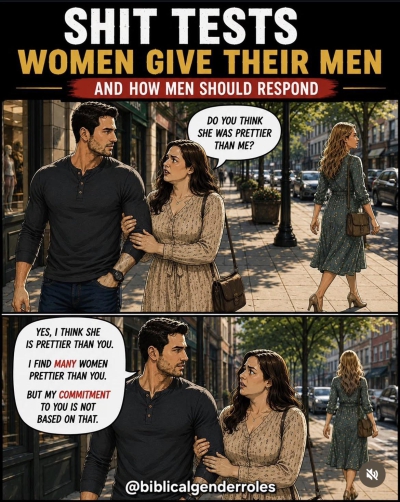
I'm kind of uncomfortable with putting this picture so prominently on this page. It draws a lot, and I mean a lot of criticism. To a large degree it does it rightly so. Just “Biblicalgenderroles”. The title “Shit tests women give their men” just flatout declares all women to be manipulative (probably because biblical gender roles generally see women with suspicion, it makes sense this account would post this shit), this picture is AI generated slop, reinforces stereotypes about women having long hair and wearing feminine clothes, and the picture presents the man as strong and powerful and in control, with how he looks and how his wife holds onto his arm with her terrified and insecure facial expression. The whole picture is just one big fail, and that's how the post on Reddit where I found the picture treats it.
…however. For this analysis, let me break down this picture into its essential parts. If we strip it of all the unnecessary and inflammatory elements and keep only what's strictly necessary, what would this look like? Well, I think I have an idea:
“
A: Do you think C is prettier than me?
B: Yes, I think C is prettier than you. I find many people prettier than you, but my commitment to you is not based on that.
”
From here on forward, this is what I will be analyzing. This breakdown is part of why I like text more than images in most cases. It lets you focus on what's necessary - for example, note how in my breakdown there is no mention of genders. There are no ages1), no facial expressions, no interference of any kind or anything that would give unnecessary context to this interaction. And, well, as much as I hate the original picture for its many faults, the message of this breakdown I think is actually quite reasonable.
The reality is that, out of the 8 Billion people on Earth, it is very unlikely that A is going to be the prettiest or most intelligent of them all. Sure, beauty (or even intelligence, for that matter) is subjective, but even if you rank people based on your personal subjective taste, it is still unlikely that A is going to be Pos. #1 out of 8 Billion people. When objectively ranked, even if ranked based on your personal preference, it is extremely unlikely that out of 8 Billion people you will find the prettiest person. You will always bump into people who you find subjectively prettier if you're honest to yourself. If A is in your 99th percentile then this will happen less frequently, but it will (basically) never not happen.
Now this might sound harsh and distasteful, but really this is the part that I think makes human love so valuable. Humans are not perfect. You will not find the perfectly beautiful and perfectly intelligent human out there. In fact, I'd argue that being together with the perfect human being might actually be boring and “imperfect” in its own right2). Humans love each other despite - nay - because of their imperfections (of course there are limits to this as well, but you get the point). While beauty and intelligence could be considered resources that we bring to the table, it's what we make out of these resources that matter in a real and dedicated relationship. That's why we can openly and honestly admit that we don't think our partner has achieved visual perfection, because - well - our commitment to them is not based on that. In fact, what really is beauty good for anyway? What is anyone going to make out of that resource? Hah, we've basically arrived at the modern sentiment that, actually, beauty does not and should not matter3).
There are a lot of concepts that play into this that I have not mentioned. For example, this whole question is a trust thing. And it's why I personally choose to give the straight answer. If I am always truthful, people around me know what they're dealing with. There aren't any games being played, no dancing around uncomfortable questions, no moments of uncertainty where a person can't be sure whether what I said is really what I think. Does he really love me? Does he think I'm ugly? There is no ambiguity with me. Of course this involves accepting a reality that is inherently imperfect and, at times, quite ugly, but once the trust is there it makes things a lot easier. If you've ever been worried about something in a relationship… that doesn't happen.
Reassurance
There was one comment that I thought was actually quite reasonable: “This isn’t about facts: the fact that someone is prettier. It’s about empathy, connection and feeling secure. But obviously this guy lacks awareness”
The problem I see here is that A asked for an opinion. I can understand the interpretation that A maybe just wanted emotional reassurance, and that's perfectly reasonable, but A could have just asked for reassurance (“Do you love me even if other people are prettier?”). But A didn't, and as far as B is concerned, B's response is perfectly valid and reassuring and there is no reason not to say it. If you interpret it the way this commenter lays it out, my conclusion would be that there is a mismatch of personalities. A expected reassurance from B, but B just gave a “straight” answer. B gave an answer that responds to the question literally.
But, in fact, I would argue that the way B responded actually was quite emotionally sensitive. B could have just said “Yes” (“Yes, I think she is prettier than you”) and left it there. Imagine that. But instead, B added that beauty is not what B's commitment to A is based on, which is a good explanation for why A shouldn't need to worry about prettier people.
I think that whether you give someone a reassuring answer or a straight answer, both options are acceptable. You, as a potentialy reassurance-seeker just have to think about whether this kind of stuff matters to you. If you are the kind of person who needs and values reassuring answers, then you probably shouldn't get together with someone who doesn't provide that. For example, I'm the kind of person who gives straight answers, but I tell people that ahead of time and then it is their choice as to whether they are okay with that or not. Some people need reassuring answers, some people don't care. This is individual preference. Now, would I reassure if asked specifically? Definitely. This is a personal incompatibility between A and B. Now, if you're already married and have yet to find this out then this is a failure on both sides that neither identified this as a problem early. This is why we spend time together before entering a romantic relationship or even marrying. Of course you can marry despite problems like this - this is not a marriage-ender - but it will put strain on the marriage. Though at some point A should wisen up to this incompatibility and realize that they're not getting the kind of response they want.
Finally, when I used the term acceptable up there to say that both a reassuring answer as well as the straight answer are actually OK, I originally used the term “good”. However, I think only the honest/straight answer can truly be classified as “good”. For utility purposes I can understand the reassuring answer being used. Still, you shouldn't ask questions where you know you'll hope someone else will lie for you to make you feel better. The honest answer provides encouragement for A to reconsider how good of a question their question was, and to hopefully not ask those kinds of questions again in the future. Or, at the very least, make it very clear next time that “hey, I'm asking this question right now for reassurance, could you give me reassurance?”, which I don't think many people will decline. I certainly wouldn't.
Outtakes
What confuses me is what people think about this. I will be using the Reddit post where I found the picture originally as an example here. Most people seem to treat this like an equivalent to B saying that they don't actually love A. Or even that B hates A. What am I saying, let's just throw the word out there: ABUSIVE.
Another says that noone should ever objectively visually compare their partner to anyone else, even if asked. What? I mean, to say that your partner is beautiful you have to compare them against your own preferences at least once, and during that process you will get some kind of idea of how beautiful you think they are. But I guess maybe you shouldn't compare them to someone else, which brings me to…
“They have not fell in love, that's why. Love literally rewires the brain to see that person as the most beautiful person.”
Now this is a scientific argument! …and on what basis? I'd like to see where the guy got this from, especially since he would probably agree with my statement that we love people's imperfections. No, we don't lose all sense of objectivity when we fall in love. An even better counter to this from another user: “Is this actually a universal experience? I find it unlikely that everyone loves the same way. Polyamory exists.”
Now, get this: “I don't know about polyamory, because I don't find it interesting at all. But norepinephrine triggers total focus and attachment to another person. And it is released a lot when falling in love. There is also release of dopamine, adrenaline and oxytocin.”
This response haunts me in my dreams. It makes me laugh and cry at the same time. First, he dismisses an argument because he is not interested in the concept that the argument is about. Secondly: Yes, good job, you did it. You mentioned all the scientific buzzwords, you did the words, well done.